A Greek Odyssey: Costas Douzinas
Updated: Aug 19
This is an informal talk I gave at a 2-day conference on 26-27 June 2026 in honour of my partner, Costas Douzinas. Talks and eulogies were given by critical legal scholars, philosophers, political theorists, and political researchers – all very erudite and serious. But I had the task of speaking about the ‘personal Costas’, as well as embarrassing him. I did my best.

The first thing Costas sees when he wakes from sleep in our Bloomsbury flat, is Sophia Kalogeropoulou’s Odyssée, a primitivist landscape weaving, in brightly coloured dots of paint, the eighth century BCE tale of a man trying to make his way home across life’s tumultuous oceans. Odysseus encounters angry gods, witches, whirlpools, and cannibals, which, in Costas' case, translate into the malicious gods of the academy, the whirlpools and deceptively deep waters of Ionian and Aegean politics, and soul-destroying cabals, along with some alluring sirens (I bound him tightly to the mast until out of danger). There were times when he didn’t think he would make it, when he found himself a ‘No-Body’ in a dark, dank place, forced to use all his ingenuity to blind his enemies in order to escape by clinging to the smelly underbelly of earthly life. But there were also times of wonder and exhilaration, adventure, leadership, heroism.
20 November 1951: a blistering hot day in Piraeus, then a port city immediately outside of Athens and now indistinguishable from the capital itself. That was when Konstantinos’ Greek Odyssey began. He was born to Phaedra, a zealous housewife with a love of garlic, and Evangelos, a ‘doctor of the poor’ who loathed garlic.

Imagine him! A honeyed altar boy serving the saints (and not a few sinners) at his local Orthodox Church; a mischievous fourteen-year-old tossing dice and flipping cards alongside gnarled old men at a local gambling den; a precocious and bored-to-death student winning every school prize; an impatient and brilliant law scholar at Athens university, politicking and fornicating with equal devotion.
Jump forward until 1974, and the Costas we know and love takes a plane from sunny Athens, landing in a cold, drizzly London-in-July. An earnest 23-year-old; the Greek junta had just fallen; a voluntary exile, seeking another home.
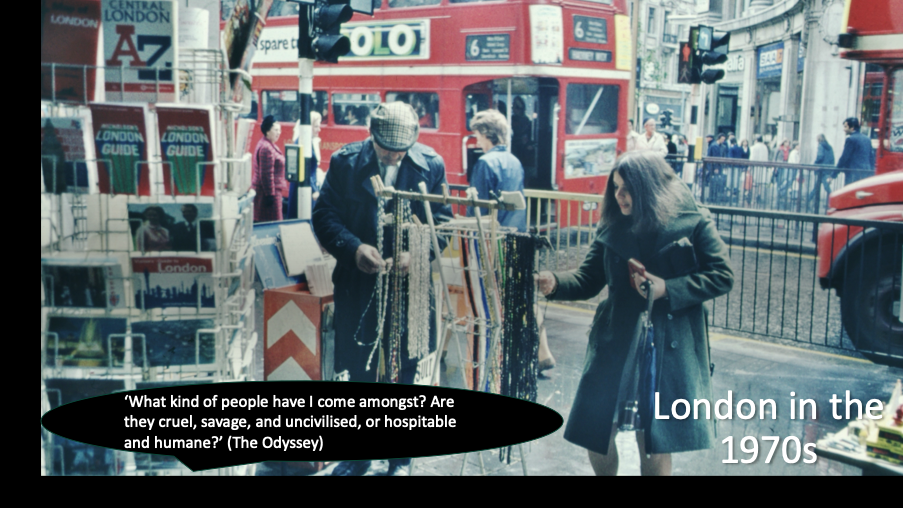
Like the original Odysseus he wondered: ‘what kind of people have I come amongst? Are they cruel, savage, and uncivilised, or hospitable and humane?’ The Britain he entered in 1974 was unlike the one immigrants face today: people were friendly to the Greeks. Everyone he met either had (or were dreaming of) basking on the warm sands of Greek islands; even those who had suffered a rather mediocre education in state schools were philhellenes in their sensibilities, revered the classics of ancient Greece. The LSE was an ideal home for him: it was teeming with radical students, many Greek, and he quickly made lifelong friends. His political radicalism neatly slotted in with his intellectual passions, which at that time included Marx, Marcuse, Foucault, Freud, and Habermas.
At the LSE, he also led what was then the largest student occupation in the UK: protesting the Labour Government’s pernicious decision to double the university fees for international students: from 125 pounds a year to a crippling 250 pounds – let me pause while you digest that: fee were raised from 125 pounds a year to 250 pounds!

His journey was not entirely smooth. His 600 pages on the First Amendment of the American Constitution dismayed his PhD examiner, the Aussie-accented John Finnis, conservative philosopher of law and as ravenous for fundamentalist readings of Catholic theology as the one-eyed Cyclops were for the bodies of beached sailors.

Even self-professed friends of Costas had a strange way of showing their affection (at least to my ears). The formidable Marxist legal sociologist, Alan Hunt, appointed Costas to a one-year lectureship at Middlesex Polytechnic, before taking him aside to inform him that: ‘you’re a lefty, you do legal theory, you have a strong accent: you won’t go far in the English legal academy’. After offering to pay for elocution lessons – an attempt to turn Costas from a ‘No-Man’ into an ‘Englishman’ (an offer Costas politely declined) – Hunt advised him to abandon his dreams of an academic life in Britain. (I have to pause here and say that Costas has a more generous interpretation of Alan’s advice, claiming that Alan must have been joking).

Just as it seemed that his enemies were planning to ‘rouse the rage of every wind that blows’ causing ‘night to spring forth out of the heavens’ and the ‘sea to break over him with terrific fury’, Costas discovered ‘deeper than oceanic’ friendships and intellectual amity. Ronnie Warrington threw him the equivalent of Ino (the benevolent marine deity)’s enchanted veil; he ‘spat out the bitter brine’, and swam to shore: Lancaster. The first Critical Legal Conference in 1985. Birkbeck (Peter Goodrich, Matthew Weait, Valerie Hoare). Like Odysseus, who taunted cannibalistic monsters from the safety of his boat, Costas then felt confident enough to parody John Finnis with his and Ronnie’s witty ‘Fin(n)nis Philosophiae: On the Deconstruction of Jurisprudence’. Henceforth, all the rocks that conservative legal scholars threw at him were nothing but lips of foam on the wave he was riding.
His dozens of books and articles were like waves crashing on a receptive academic shore.

Let’s move this story a bit faster! Homer’s Odyssey stretches over 24 chapters, but we don’t have that amount of time. In the book accompanying this conference, Rights, Resistance, and Critique: The Legal Theory of Costas Douzinas, edited by Alexis Alvarex-Nakagawa and Illan rua Wall, I had the unenviable task of mapping out Costas’ institutional triumphs, especially at Birkbeck. I trust that, since you can buy and then consult that book for his Birkbeck life, I will not talk about it. Equally: his intellectual odyssey in Britain (and every continent in the world) is being covered by numerous distinguished scholars, so I will also pass over those stories.

(It can be purchased at this link: https://www.routledge.com/Rights-Resistance-and-Critique-The-Legal-Theory-of-Costas-Douzinas/Alvarez-Nakagawa-Wall/p/book/9781032622248)
Only two things demand attention before I address Costas’ Greek Odessey: the two absolutely best things that happened to Costas during his long sojourn in Britain are, first, the birth of his daughter, Phaedra, who has now joined her mother, Alexandra, as a distinguished anthropologist. The second was when his Penelope (or raw antipodean equivalent) did what Homer couldn’t imagine: she threw away her loom, abandoned her 108 lovers and, rather than sitting at home weaving dreams of her hero, decided to accompany him on his perilous journeys through the seas. Homer, be damned!

We did not know it then, but an ordeal worst that anything devised by the vengeful Poseidon, or the sucking whirlpool Charybdis, or even the cruel, six-headed Scylla, was about to be thrown at us. This was Costas’ impetuous decision to get involved in Greek politics. I say ‘impetuous’ but, in hindsight, there were signs. The global 2008 crisis and 2010 Eurozone debt crisis sparked political fury in our Costas. Overnight, he saw his beloved Greece being destroyed; Hellenistic Brits, bloated with bigotry. Articles and position-papers flowed out of him: The Guardian alone published dozens, but also the Greek Left Review, Democracy Now, Open Democracy, Naked Punch. His articles were rapidly translated and republished in the Greek media. [I] He was invited by the Greek indignados to address the occupation of Syntagma square in Athens. It was a time of heightened emotions, with protestors in the upper section of Syntagma shouting anti-parliament slogans such as ‘burn, burn, brothel of a Parliament, burn’ [why does the Right have the best chants?] and gesturing with moutzes, while Costas represented the much larger group of occupiers in the lower section of the Square, calling out for democracy and the end to austerity.

To no avail. Greece was plunged into austerity, more punitive than that imposed in Ireland or Iceland because punishment was made to match perceived moral laxity. Sovereign decision-making was given to unelected European bodies, stripping away that democracy for which so many Greeks had spilt their blood. Billions were given to the banks socializing their debts, while Greeks eking a living on 600 Euros a month were condemned to collective punishment. The country’s GDP was slashed by 28 per cent; salaries and incomes, halved. Unemployment soared. As in The Odyssey, danger came in multiple forms but, in Greece, it was the one-eyed Cyclops of neoliberalism and neocapitalism, which snatch humans at random, ‘ripping them limb from limb… leaving no scraps, devoured entrails, flesh and bone, marrow and all’.

The leftwing populism of Syriza sought to return power to ‘we, the people’. They echoed Odysseus’ cry: ‘We, the No-Bodies, can destroy you’ or, as Costas put it in 2010, the insurrectionists were saying, ‘We, the nobodies, the schoolkids, the students, the unemployed, the generation that must survive on a salary of 600 Euros, are everything’. Syriza won the election in January 2015.
Enraged, the supranational, neoliberal seductress of Europe tightened its controls: this was the Troika of the European Central Bank, International Monetary Fund, and the European Commission. On the surface, she was a seductress like Circe, the great cunning goddess and master of pharmakeia in Odysseus’ travels, who sang ‘most beautifully’ from the neoliberal songbook as she wove ‘a web so fine, so soft, and of such dazzling colours’ that all who approached were trapped. Like Circe, the Troika drugged their victims ‘with wicked poisons to make them forget their homes, and when they had drunk she turned them into pigs by a stroke of her wand, and shut them up in her pig-styes’.Portugal, Italy, Ireland, Greece, and Spain were turned into PIIGS. It was in the power of the Troika to make the PIIGS ‘grunt just as pigs do’ even though ‘their senses were the same as before, and they remembered everything’. Racist assumptions flared: Greeks cannot control their appetites; they don’t pay taxes, are lazy, are uncivilized, expect to retire to their home island in their forties. They are not ‘white’.

Within nine months of the Syriza government being held hostage, Tsipras resigned and called another election. And so it came to pass…..
On Saturday, 5 September 2015, Costas was attending the Critical Legal Conference in Poland, when his phone began ringing in his hotel room. New elections for later in September had been announced and Syriza wanted Costas to stand as an MP. No. They kept calling. No. They promised him that he had no chance of being elected, even in his own city of Piraeus. I was on a lecture tour in Australia and remember getting a frantic phone call from an uncharacteristically indecisive Costas: should he do it? I had no choice but to say ‘Yes’.
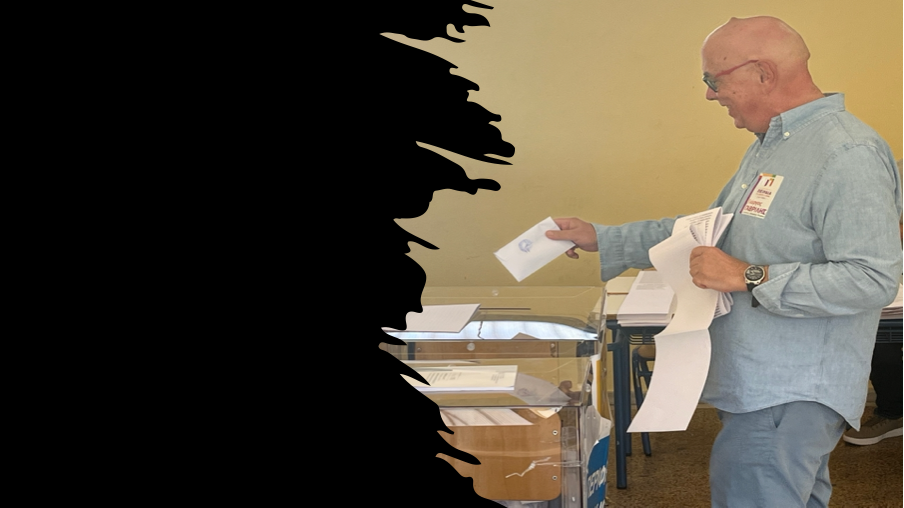
His name went forward on the understanding that this would enable him to campaign but without an expectation (let alone desire) to win the seat or leave Birkbeck. He didn’t even bother to inform the timetabling colleagues at Birkbeck. We both remember our panic when, on election day, it became clear that a groundswell of support for Syriza resulted in his election as MP in his home-city of Piraeus. On 20 September 2015, Costas became an ‘accidental politician’. After nearly 40 years in London, Costas and I returned to Greece.
Within a couple of weeks of being ‘driven… by foul winds’ into Parliament, he was elected Chair of the House Standing Committee on Defence and Foreign Relations, the most senior of the committees. There, he had the misfortune of having to work with (and hold to account) two of the most difficult Ministers in government: the Minister of Defence, the emotionally explosive leader of the fanatical nationalist Independent Greeks, with whom Syriza was in coalition, and the Foreign Secretary, a cagey, intemperate Left-nationalist. There were also fraught moments of threat and real aggression: on more than one occasion, I found myself between him and a group of irate nationalists or neo-Nazis and, like a true Bloomsberry Stratchian and pacifist, I threw myself between them.

When he first arrived in Britain, Alan Hunt had advised Costas to take elocution lessons to improve his English; now, after nearly four decades in Britain, he found himself barely able to master political-Greek. A five-minute radio or TV interview would require preparation of at least an hour. Journalists and his fellow politicians quickly dubbed him ‘The Professor’ or ‘The Philosopher’ – sometimes this was said with respect; many times, with thinly veiled scorn. For the first time in history, the words ‘hermeneutics’ and ‘deconstruction’ were spoken from the Parliamentary lectern, along with the names of Derrida, Nancy, Badiou, Ranciere, and Žižik.
Time and again, he was told to give up thinking as a philosopher, academic, and critic. As was Odysseus after being dumped unceremoniously on the island of the Lotus-Eaters, he was instructed to ‘eat of the lotus, which was so delicious that those who ate of it left off caring about home’ but strove only to stay elected. They told him that it was impossible to combine politics and academic work and urged him to ‘think no further of a return’. Ever the contrarian, Costas begged to differ. During tedious debates in the Chamber, he could be seen typing furiously on his computer. The result was three books in English and one in Greek: Resistance and Philosophy in the Crisis; Syriza in Power: Reflections of an Accidental Politician; The Radical Philosophy of Rights; and Από την Έδρα στα Έδρανα (From the University Chair to Parliament’s Benches).

Resisting the lure of the Lotus-Eaters – the parliamentary equivalent of honeyed fruit,
loukoumi, baklavas – and subsequently forgetting all critical thought was only one temptation slain. There were also the sirens of patronage and clientelism, nepotism and corruption. The Sirens, birdwomen who sing so sweetly as they entice men to a watery death, called out to him: ‘Come here. No one ever sailed past us without staying to hear the enchanting sweetness of our song – he who listens will go on his way not only charmed, but wiser’ in the ways of Greek politics. Looked at with a clear vision, the Sirens who ‘beguiled’ politicians by convincing them that corruption ‘is and always will be’ (proffering ‘temptation of temptation’, as Levinas might have put it), were actually responsible for creating ‘great heap of bones of moldering men’. Foolhardy or courageous, you decide, but Costas, emulating the great Odysseus when tempted by the Sirens of his time), took ‘a large wheel of wax… kneaded it till it became soft under the rays of the [Greek] sun-god’, and used it to stop the ears of his parliamentary researchers who, in turn, obeyed his injunction to bind him tightly to the mast of integrity.

The difficulties were offset by the successes. But some high points that I might mention are:
pushing through a parliamentary resolution recognizing a Palestinian state along 1967 borders, with East Jerusalem as its capital (which generated a fraught discussion about the difference between ‘the Palestinian state’ or ‘a Palestinian state’) and welcoming Mahmoud Abbas, President of the Palestinian authority, to the Greek Parliament; establishing the framework for introducing radical constitutional reform; negotiating and passing the Prespa Agreement between Greece and Northern Macedonia (which ended one of the longest running disputes in Greece’s foreign policy); founding the first Law School in Cyprus; supporting a resolution introducing civil union rights to LGBTQ+ people and allowing changes to one’s gender identity; establishing the Ideas Lab in Room 227 in which every Wednesday leftwing MPs would meet to discuss theoretical and political ideas; ingloriously marching the leader of the neo-Nazi Χρυσή Αυγή (‘Golden Dawn’) party out of the Chamber; and campaigning to improve the position of refugees and immigrants. After my talk, Elena Psyyakou and Dionysis Mitropoulos (his Parliamentary researchers and campaigners, without whom nothing would have happened) will explore in greater detail these political events.

Then it all came tumbling down. Syriza lost power to the centre-right New Democracy party in 2019. It was exhausting. The smoke-filled rooms that he could not avoid if he was to lobby his fellow-MPS; the unbearable long-hours; the deafening number of phone calls; the impossibility of forging powerful networks without money-under-the-proverbial-tables. Like Odysseus, ‘His body was all swollen, and he… lay swooning from sheer exhaustion’.
It was a frustrating voyage to find poros, a pass from a cruel world to a home, wherever that might be. But it was also an exhilarating time. Since leaving Parliament, it has included numerous other adventures – as the President of the Nikos Poulantzas Institute (the left-wing thinktank); as Councillor for his beloved Pireaus; as writer of regular columns in Greek as well as international newspapers and radio broadcasts. He is truly ‘lion-hearted’; loyal to a fault; with a gift for friendship. He sheds tears, like Odyseus, for the poor and downtrodden. He is a ‘man of tactics’, flexible, canny. There is a lovely Greek term for this: polytropos which means many things: versatile, witty, cunning, resourceful, creative, many-turning. He sincerely hates being spoken about – these talks the past couple of days are embarrassing, even mortifying, for him. But, that said, like the loyal swineherd Eumaeus in The Odyssey, he delights in telling stories, even about misfortunes; ‘for when a man has been… buffeted about in the world, he takes pleasure in recalling the memory of sorrows that have long gone by’. Costas is always on the move. He ‘saw the cities and came to know the sensibilities of many peoples’, all struggling for a new homecoming or nostos.




Comments